Why symbols exist
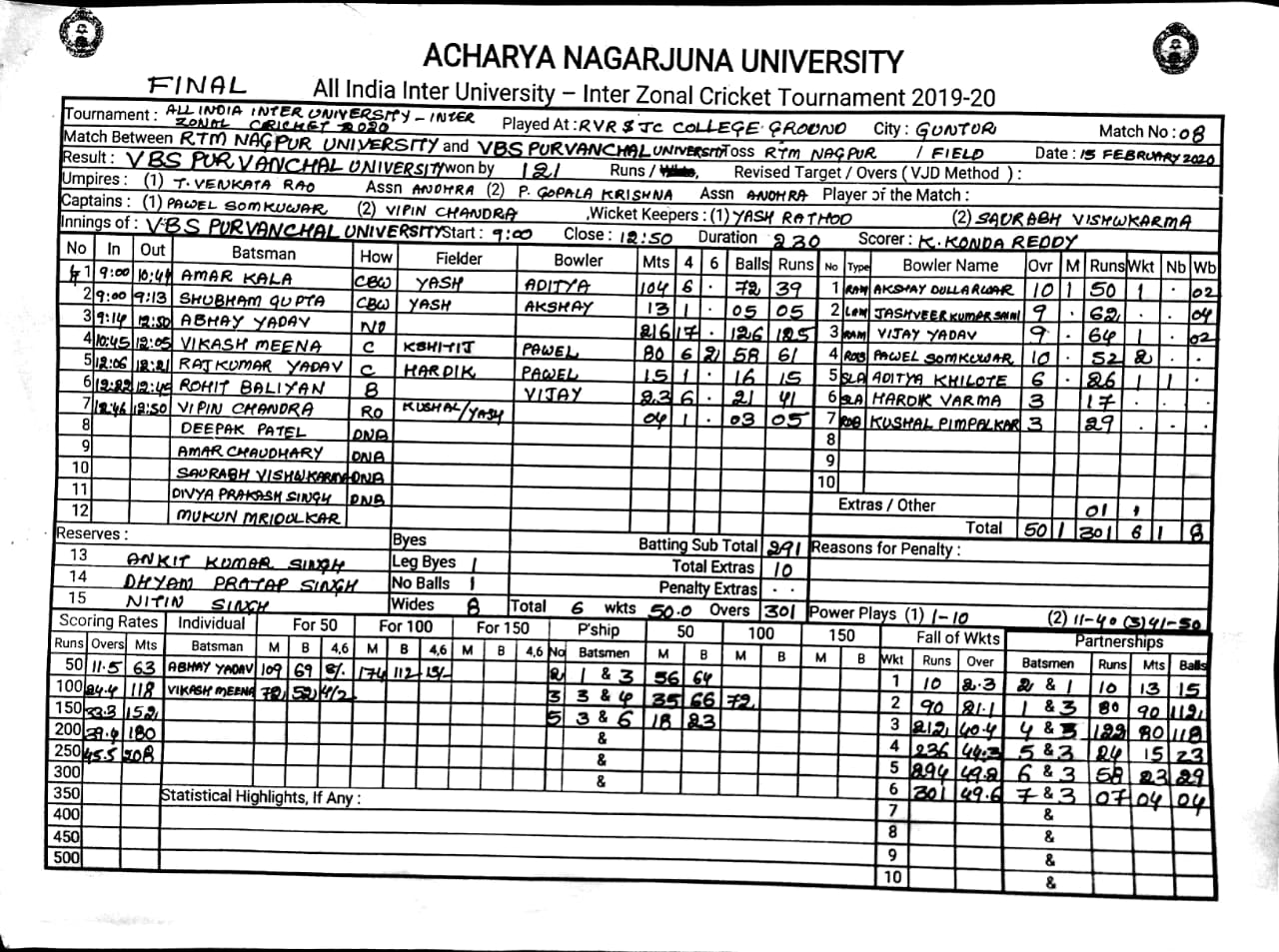
A scorebook has one small square for each ball. The symbol in that square has to tell a stranger what happened, quickly and without ambiguity. Two scorers who use different symbols for the same event will produce different extras columns, and the tables built from those columns will disagree.
The core marks
- • (or 0) is a legal ball from which no run was scored.
- 1, 2, 3 are runs off the bat. Write the number the batters ran.
- 4 and 6 are boundaries, but only if the ball reached the rope off the bat. If the ball went for four byes, write the extra, not a four.
- W is a wicket. Write the mode beside it: b (bowled), c (caught), lbw, st (stumped), ro (run out), hw (hit wicket).
Extras
- wd — wide. Not a legal ball. Add the wide and any extra runs run off it.
- nb — no-ball. Not a legal ball. The no-ball run is credited to the extras line, and any runs off the bat are credited to the batter.
- b — bye. Legal ball. Runs not off the bat or the batter's body.
- lb — leg-bye. Legal ball. Runs off the batter's body, not the bat, after the ball hit the pad or body.
A wide plus a run to the keeper is not a one. It is a wide and the extra run. A no-ball hit for four is a four to the batter and one run of no-ball.
Combined marks
Many clubs use compact combinations to save space:
- wd+4 — a wide that went to the boundary. Four runs go to extras, not the bowler's batting figures.
- nb+1 — a no-ball with a single off the bat.
- nb 4 (ro) — a no-ball with a run out off the same delivery.
Write the combination the same way every time. Consistency matters more than the particular system.
Symbols for the bowling analysis
The bowling figures are built from the symbols. Dots and runs off the bat count against the bowler. Wides and no-balls count against the bowler too, but they do not count as legal balls. Byes and leg-byes do not count against the bowler's runs, but the balls still count toward the over.
Why clubs fight about this
If two scorers use different marks for the same no-ball, the bowling analysis and the extras column diverge. Pick a house style and print it at the top of the book. Put the symbol sheet on the scorers' table.
A worked over
Suppose a bowler sends down: a dot, a wide, a four, a leg-bye, a single, a no-ball hit for six, a wicket (caught), and a dot. The book reads: • wd 4 lb 1 nb6 W(c) •. The over has six legal balls in it, eight deliveries in total, and two extras entries before the wicket.
Citations
Symbol conventions vary between clubs; these are common practice. The Laws define what counts as a legal ball, an extra and a boundary.
Match questions
Questions scorers actually ask
- 01 Is a no-ball a legal ball of the over?
- No. Like a wide, it does not count as one of the six legal balls.
- 02 Do I write a bye as a four if the ball crossed the rope?
- No. A boundary off the bat is a four. A ball that reaches the rope as a bye is four byes, recorded as an extra.
- 03 What does W(c) mean?
- A wicket, caught. Writing the mode next to the wicket lets anyone check the analysis later.
- 04 Should the symbols be the same at every ground?
- Within one competition, yes. Across competitions, the symbols are the same idea but the house style differs, so check the league rules.