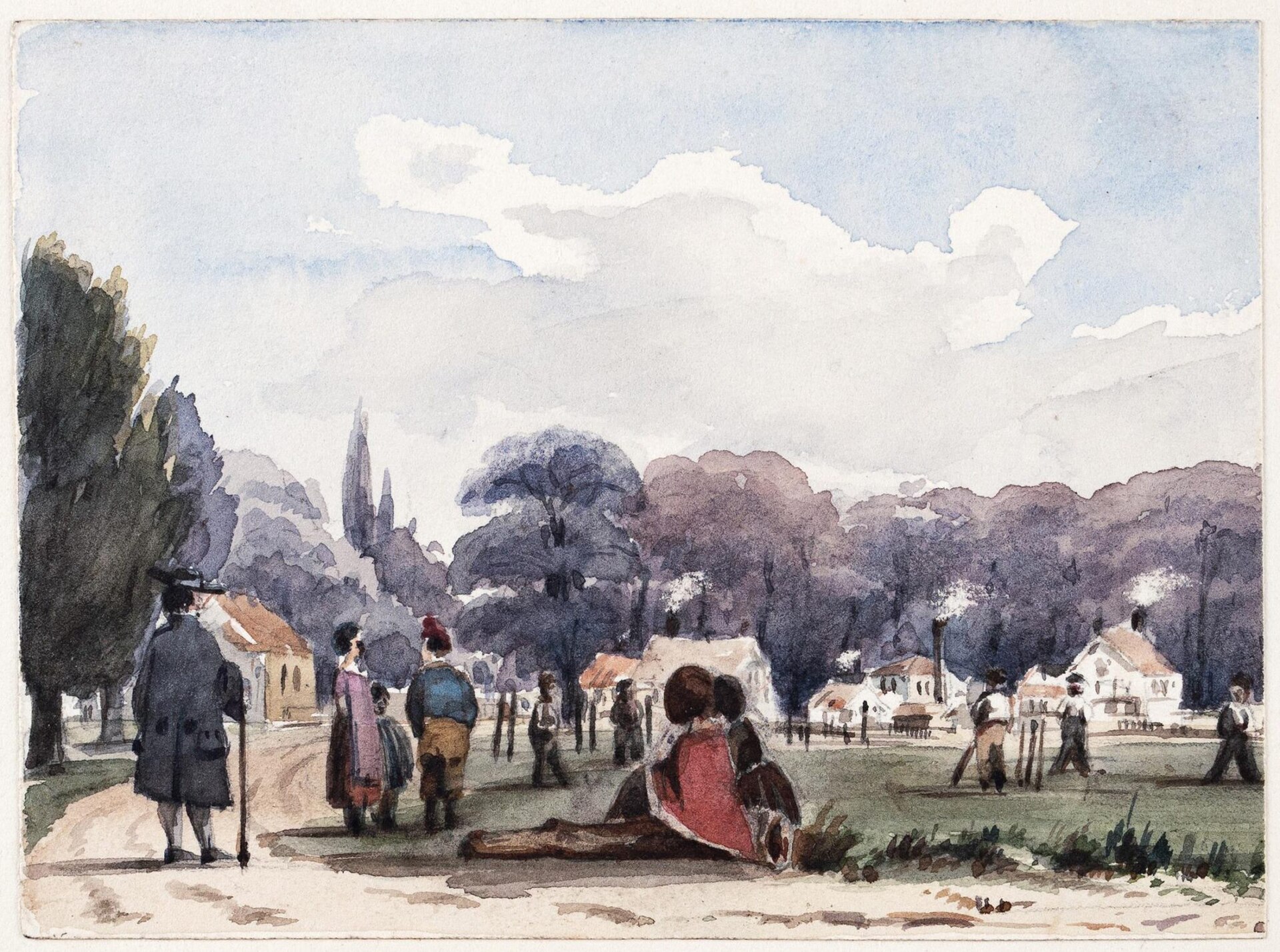
A game before it was a sport
The earliest widely accepted unambiguous reference to cricket comes from a Surrey court case in 1598, in which a man recalled playing "creckett" on a plot of land as a schoolboy some fifty years earlier. That is the shape of the early evidence: not fixtures or scores, but people mentioning in passing that the game already existed.
For most of the seventeenth century cricket lives in that margin — parish games, occasional prosecutions for playing on a Sunday, the odd wager. It is a village pastime that adults gradually take over.
Written down because of money
Cricket got organised for the same reason many sports did: people were betting on it. Stakes require agreement about what happened, so the eighteenth century produced the first written codes. A set of Laws survives from 1744, covering the pitch, the wicket, and the duties of the umpires in language a modern scorer can still follow.
The Hambledon Club in Hampshire became the strongest side of the era and its de facto rule-maker, and the Marylebone Cricket Club, founded in 1787, inherited that role. MCC has been custodian of the Laws ever since, which is why a club scorer in Nepal or Nairobi is still working from a document maintained in London.
The changes that made it recognisable
Three shifts turned the eighteenth-century game into the one on television.
Bowling changed first. Deliveries were originally rolled or skimmed along the ground; the ball was pitched through the air, then bowled roundarm, and overarm bowling was finally legalised in 1864. Each change made batting harder and forced the bat itself to change shape — from a curved hockey-stick profile to the straight blade that suits a bouncing ball.
Second, the lbw law and the three-stump wicket closed the loopholes that let batters simply block or ignore the ball.
Third, cricket travelled with the British Empire, which is why the international game is shaped by a specific list of countries rather than a natural spread. Tests began in the 1870s between England and Australia; India, the West Indies, New Zealand, and South Africa joined over the following decades, and the map has kept widening since.
Why the history matters at the scorers' table
Almost every quirk that confuses new scorers is a fossil. Extras exist because the bowler is charged for some things and not others. A wide is not a legal ball because the over was defined before anyone thought about bowlers exploiting it. The Laws are a record of arguments that were settled once, in writing, so they would not have to be settled again on a Sunday afternoon.
What the early records do and do not tell us
The surviving records are thin. Most of what we know comes from court cases, wagers and the occasional newspaper report, and the people writing them were not trying to describe the game for historians. That means the early history is a patchwork: confident about some dates, vague about how the game was actually played. Treat any claim about a single inventor, or a single moment of creation, with caution.
Why the Laws matter for scorers today
The written Laws grew out of disputes, and most of the rules a scorer uses today answer a question that someone once got wrong. When a wide is not a legal ball, or when a batter can be stumped only when they are out of the crease, the rule is a record of an argument that was settled long ago. Reading the Laws with that history in mind makes them easier to apply.
Where to read the Laws yourself
The MCC publishes the current Laws and the notes that explain them. Competitions add local playing conditions on top, so the Laws are the starting point and your competition's rules are the final word.
Match questions
Questions scorers actually ask
- 01 When was cricket first written down?
- A set of Laws survives from 1744, and MCC took over custody of them after its founding in 1787. References to the game itself are much older, from the late sixteenth century.
- 02 When did overarm bowling become legal?
- In 1864. Before that, bowling moved from rolling along the ground, to pitched underarm, to roundarm, each step contested at the time.